

As we close out the 75th anniversary season, a look back at NHRA's 25th
The early Hart of the NHRA
Don Garlits and Darrell Gwynn; their lives in words and photos in new books

Random ramblings and rumblings, the sequel
Random ramblings and rumblings
-
Memories of Englishtown
Remembering Steve Ambrose

Right back where we started from: Winternationals is back at No. 1

Meet Larry Wood: The man whose designs launched a million hot rod dreams

Can you imagine a toymaker designing your Top Fueler? 'Snake' and 'Mongoose' could

For the love of old drag racing photos

The ultimate Funny Car winners quiz

Still popular after all these years: Catching up with fan favorites Eddie and Ercie Hill

Eddie Hill, the early years
55 years ago, Don Garlits forever changed the look, feel, and future of Top Fuel racing

- ad
On a roll: A look at some all-time great NHRA Drag Racing success streaks

NHRA's Top 75 Moments: Bernstein, 'Big,' and Shirley reflect on making history

Funny Car set to turn 1,000: A look back at the milestone races along the way
Beyond the Top 75s ...
Wait ... Jim Head was in a 1960s surf band promoted by a drag racing legend? Yep.
More Martin memories
The Popular Hot Rodding Championships put U.S. 131 in the national spotlight
Friends we lost in 2025
Re-telling NHRA history: The 75th anniversary book and other special projects
It was John Force's world, and we were all thrilled to be living in it
- ad
The Joyce of Drag Racing Photography
Two legends: 'Big' and Bakersfield
When did we start doing that? Tracking some of the biggest changes in our sport
From 10-time dominators to one-time winners, a history of Indy Top Fuel champs
Legend to legend: Don Prudhomme on Don Garlits, Indy, and other great takes
As we close out the 75th anniversary season, a look back at NHRA's 25th
We’ve spent the 2026 season saluting the long and amazing 75-year history of NHRA, saluting our greatest moments and stars, and everyone who’s at all tuned into what we do knows how far we’ve come in 75 years, from the nascent days of competition with modified street cars on dirt roads and military airstrips to precision-refined machines hurtling down today’s palaces of speed.
We’ve seen the domination of the Kalitta Motorsports cars of Shawn Langdon and Doug Kalitta in Top Fuel, the six-way dogfight in Funny Car, and the back-and-forth battles for class supremacy between the KB Titan and Elite Motorsports teams in Pro Stock and the Vance & Hines and Matt Smith Racing squad in Pro Stock Motorcycle.
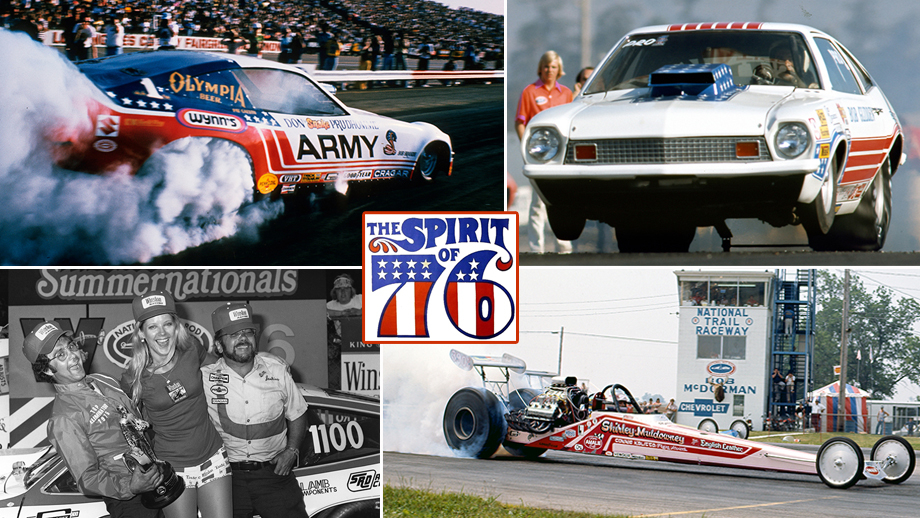
The champions have yet to be decided, headed for another dramatic showdown in Pomona, but you don’t saddle up to the bar at this watering hole for today’s news, do you? Nope, this column has made its bones on the deep history of this sport, so before 2026 punches out, let’s take a ride back 50 years to see what life was like in 1976 during NHRA’s Silver Anniversary year.
Unlike this year’s multifaceted birthday party — highlighted by NHRA’s Top 75/50/25 driver awards, a celebratory website, history-telling books, legends appearances and autograph sessions, and more — the 25th celebration was way more understated, with minimal fanfare from what I can tell. There was no 25th anniversary logo or pervasive signage and not much hoopla that I could find while reviewing that year’s issues of NHRA National Dragster.
But the racing was as good and wild as it was this year.
THE SCHEDULE
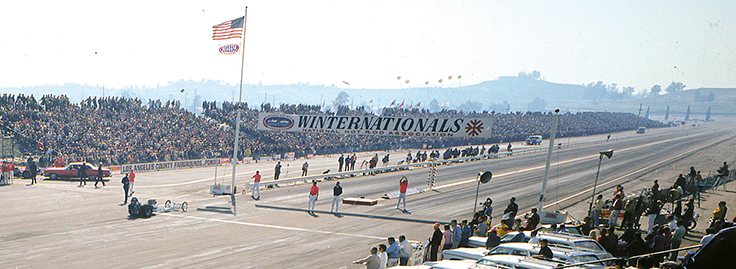
There were just eight races in the second season of the Winston-sponsored series back then: the Winternationals in Pomona, Gatornationals in Gainesville, the Springnationals in Columbus, the Summernationals in Englishtown, Le Grandnationals outside of Montreal, the U.S. Nationals in Indy, the Fallnationals in Seattle, and the World Finals in Ontario, Calif. Unlike today, corporate sponsorships were not attached to event names other than Le Grandnational, which was sponsored by Molson beer, and, to the best of my memory, only Hot Wheels had also sponsored an event, the Supernationals, a few years earlier.
NHRA had a ninth “national event,” the new Cajun Nationals in Baton Rouge, La., but it was a trial affair, billed instead as a National Open. It would join the schedule in 1977 and remain a sweaty trial by fire until 1990.
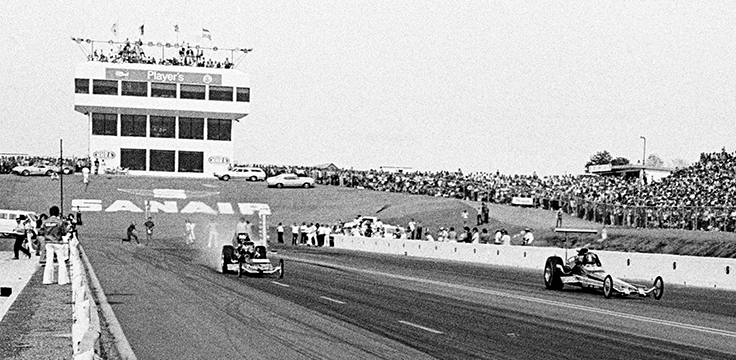
Few of the tracks had anything near a VIP tower so common today. If you wanted to entertain a sponsor, they probably sat in the grandstands instead of enjoying shrimp cocktail in an air-conditioned suite; though, again, Le Grandnational was an exception as Sanair Dragstrip had a massive tower complex behind the starting line.
NHRA fans, who had been saddled for years with months-old race highlights packages on Wide World of Sports sandwiched between arm wrestling and ski jumping, were thrilled when NHRA and Diamond P Productions announced a three-race, nationally syndicated television package for 1976 that included 60-minute broadcasts of the Gatornationals, Springnationals, and Winston World Finals.
NEW RULES
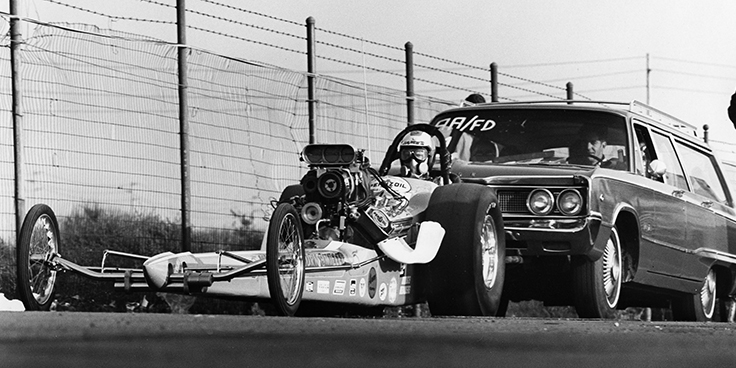
To the horror of the Top Fuel faithful, push starts, which had been part of the class practically from its inception, were outlawed beginning in 1976. The reasons were many, led by safety after numerous stuck throttles and turnaround mishaps, and increasing the pace of the show.
Arm restraints would be highly recommended in Top Fuel for 1977 and mandatory in 1978. In Funny Car, roof escape hatches would be required in 1977.
NHRA refined Pro Stock rules for 1976, including the use of big-block engines (366 cid or larger in original production form) in cars with a wheelbase smaller than 105 inches. It would be six more years before NHRA adopted the 500-cid rules across the board after years of fiddling with weight breaks that pleased no one.
FUNNY CAR: UNSTOPPABLE 'SNAKE'
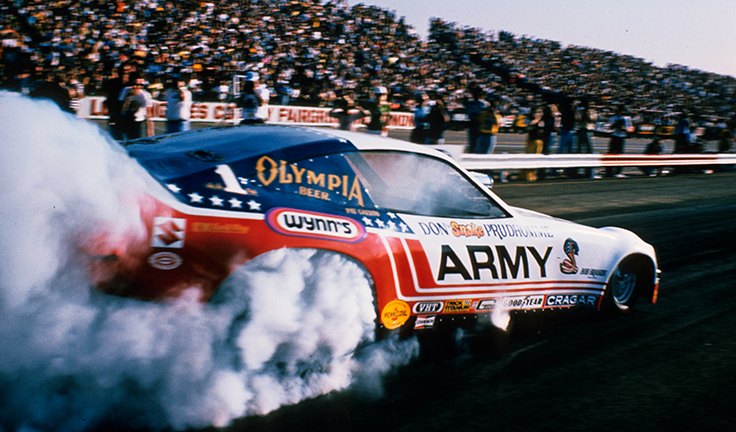
Let’s start with the obvious headliner of the year in Don “the Snake” Prudhomme, who won seven of the season’s eight events, losing only in the final round of the U.S. Nationals to Gary Burgin. On a percentage basis, it remains the most dominant season in NHRA history (87.5%); only the 2023 campaign of Pro Stock Motorcycle’s Gaige Herrera (11 wins in 15 starts, 73.3%, comes close).
Prudhomme’s U.S. Army-sponsored Monda was the class’s dominant qualifier, low-e.t. producer, frequent top-speed leader, and nearly perfect race-day closer. What made Prudhomme’s year especially impressive is that his dominance was not narrow. It was not built only on race-day luck, nor only on qualifying performance; he ran rampant on the stats sheets, too. He was No. 1 qualifier at seven of eight events, with Burgin’s Gainesville No. 1 the only interruption. Prudhomme set low e.t. at every event and also posted multiple top-speed marks, including the season-best 240.00 mph at Ontario Motor Speedway. Prudhomme, who had recorded Funny Car's first five at the end of the 1975 season in Ontario, Calif., (a non-backed-up 5.98), set the national record at 6.02 in his Pomona win, shattering Raymond Beadle’s 6.14 mark from the 1975 U.S. Nationals.
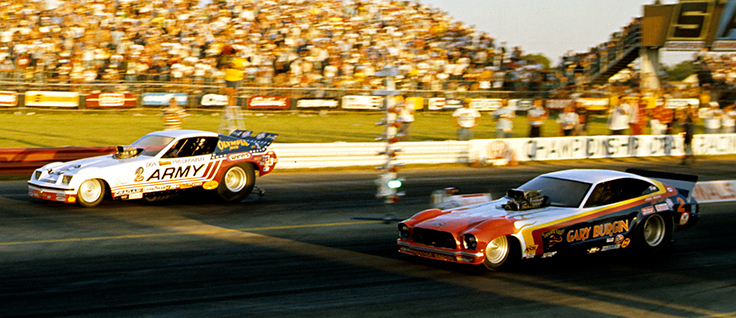
At the 1976 U.S. Nationals, Prudhomme qualified No. 1 and set low e.t. with a 5.978, the only sub-six-second Funny Car elapsed time of qualifying (Beadle was a distant second at 6.07) to again reset the national record, but Burgin, who qualified fourth at 6.12, defeated him in the final. Burgin also had top speed at that event, giving his Indy win legitimate statistical support rather than making it look like a pure upset. Still, that race stands as the sole interruption in what was otherwise a full-season Prudhomme sweep.
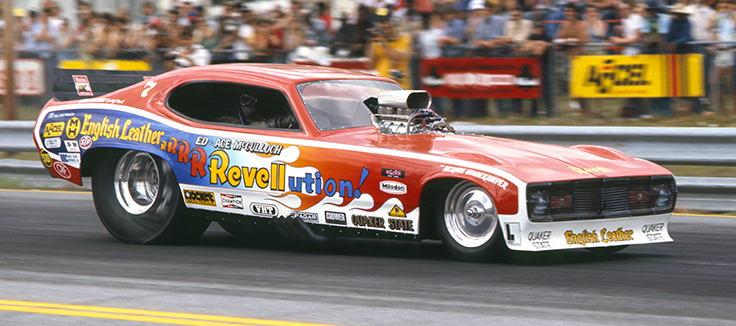
Ed “the Ace” McCulloch reached three finals and was runner-up to Prudhomme each time. Prudhomme’s former partner and longtime rival Tom “the Mongoose” McEwen reached two finals, both also against Prudhomme. 1974 world champ Shirl Greer, Tom Prock (current star Austin Prock’s grandfather), and Burgin each made one final. The fact that five different drivers finished runner-up shows that there were plenty of credible challengers, but there was just one driver operating at a different level as Prudhomme owned the class from Pomona through Ontario.
TOP FUEL: PARITY REIGNS IN HISTORIC SEASON
The Top Fuel national records at the end of the season were held by Don Garlits at 5.63 and 250.69 mph, recorded at the 1975 season finale in Ontario, and that e.t. record would stand for nearly seven years.
Garlits' long-simmering feud with NHRA and president Wally Parks came to a head over prize money, and "Big Daddy" simply refused to defend his 1975 world championship, not making a single appearance all season, leaving a bit of a power vacuum. As a result, the 1976 Top Fuel season was defined less by outright domination than by a broad distribution of winning power.
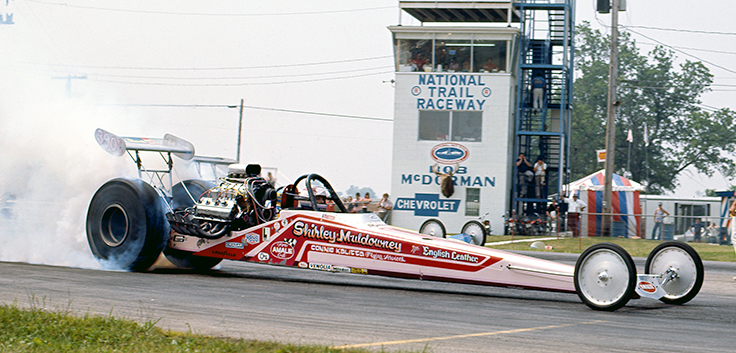
Unlike Funny Car, where Prudhomme clearly controlled the season, Top Fuel victories went to six drivers in the eight events, highlighted by Shirley Muldowney’s breakthrough win at the Springnationals and her win at the World Finals. Muldowney did not simply win in Columbus and Ontario; she swept the performance categories: No. 1 qualifier, low e.t., and top speed. Her 5.772 in Ontario was the quickest Top Fuel elapsed time of the season, and her 249.30 mph at the same event was the fastest speed.
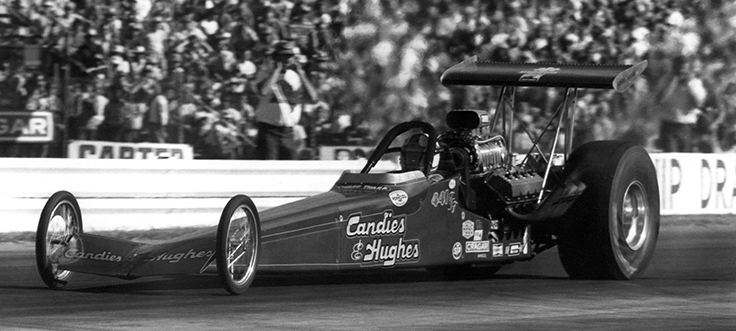
Richard Tharp won in Indy and Englishtown (as well as at the Cajun Nationals) en route to winning the championship in his first season in the Candies & Hughes entry, with Gary Beck (Montreal), James Warren (Gainesville), Frank Bradley (Pomona), and Jeb Allen (Seattle) also scoring event wins.
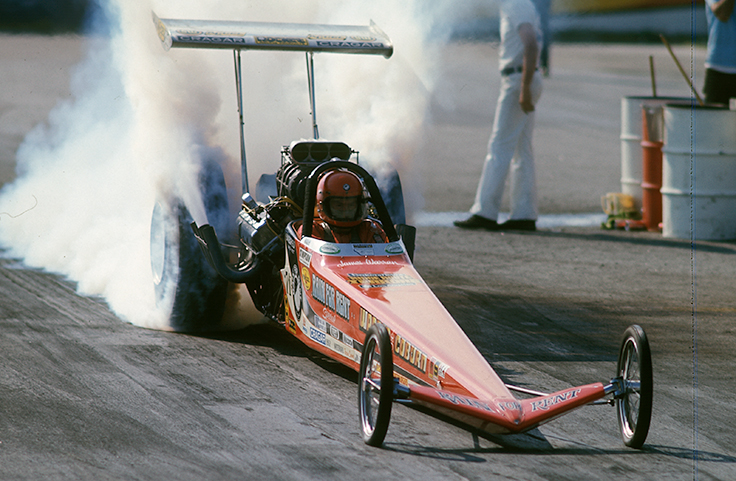
Dale Funk opened the year with the Pomona No. 1 qualifying spot and low e.t., but Bradley won the race. Beck was repeatedly quick and fast — including No. 1 qualifying efforts and low-e.t. or top-speed marks — yet his lone win came at Sanair Super Speedway. Warren won Gainesville and later qualified No. 1 in Seattle, but he did not turn that into a multi-win season. There was a clear separation between being the performance leader and being the eliminations survivor, as reliability and attrition were central to the narrative as teams continued to press for bigger performances and often overstressed the parts of the day.
PRO STOCK: THE SHIFTING BALANCE OF POWER
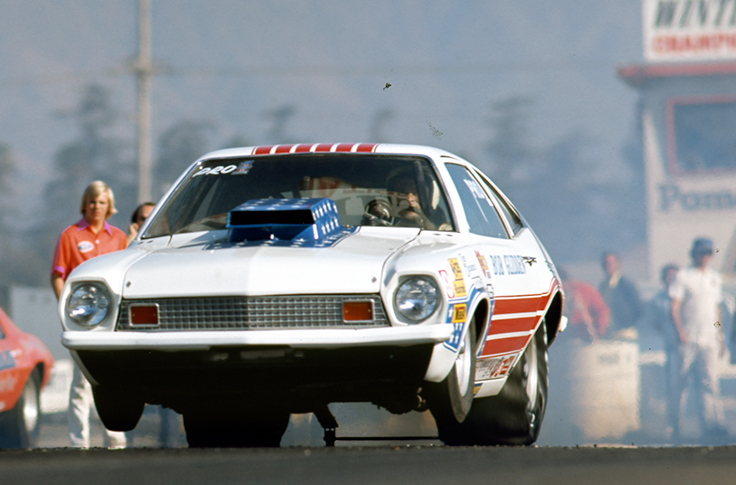
Pro Stock in 1976 had neither Top Fuel’s broad parity nor Funny Car’s one-driver domination. Instead, the season developed in phases. Bob Glidden, well on his way to becoming the force in the class, struck first in Pomona in his Ford Pinto but didn’t win the rest of the season and actually failed to qualify at the U.S. Nationals in an ill-fated attempt with a big-block-powered Monza. Larry Lombardo became the midseason force in Bill Jenkins’ Grumpy’s Toy Monza, and Wally Booth finished as the class’s most successful winner in his AMC Hornet.
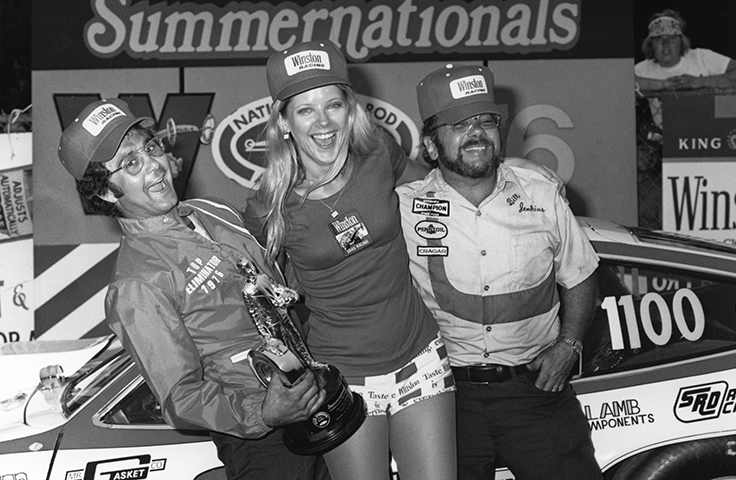
Booth won four of the eight events, including three of the final four races: the U.S. Nationals, Fallnationals, and World Finals after winning the Springnationals earlier in the year. Lombardo, meanwhile, won Gainesville, Englishtown, and Sanair, and he repeatedly set low e.t. His 8.590 at Sanair was the quickest Pro Stock elapsed time of the year (Bob Glidden’s 8.72 entered the year as the national record), and his No. 1 qualifying and low-e.t. performances in Gainesville, Englishtown, and Indianapolis show that his Jenkins Monza was one of the class’s most potent cars. Lombardo defeated Booth in the Sanair in their own final-round meeting of the season after Booth qualified No. 1.
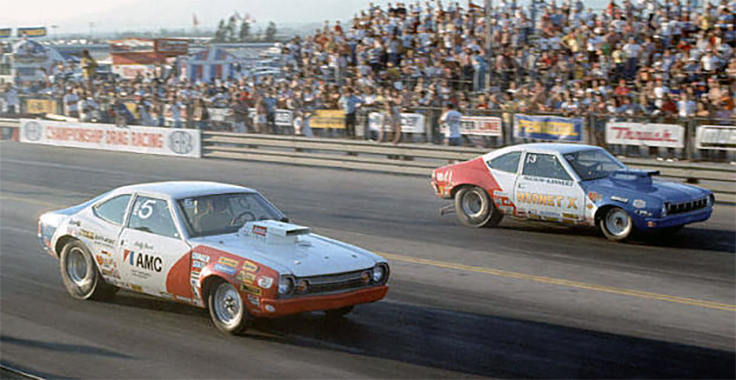
Booth won more races, but Lombardo won the championship. The final event of 1976 featured the sport’s first and only all-AMC Pro Stock final, in which Booth scored a holeshot win over Dave Kanners in a battle of matching red, white, and blue Hornets. Nevertheless, Booth’s victory wasn’t enough to overtake Lombardo, who was crowned the champion following a dramatic 9.00 to 8.91 holeshot win over second-place Warren Johnson, whose title hopes ended on the starting line when his line-loc reportedly malfunctioned. Booth finished third in the season standings.
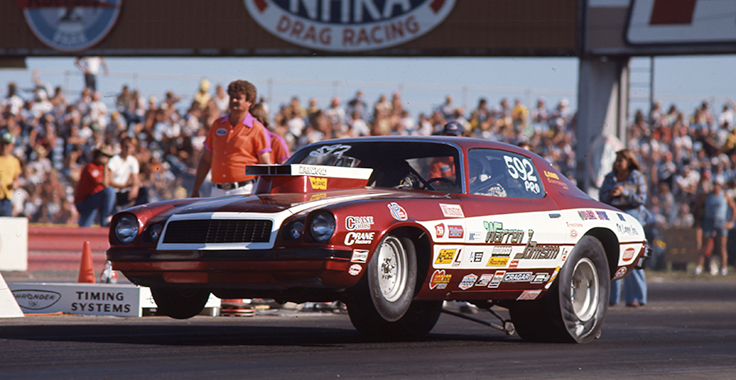
Six years before he’d win his first national event, W.J. began to emerge as a future force. He was runner-up in Gainesville, Columbus, and Seattle and posted several top-speed marks, including the fastest Pro Stock speed listed, 158.73 mph at Sanair (also better than Glidden’s 1975 record of 156.25 mph). Kanners reached two finals, qualified No. 1 and set low e.t. in Ontario, and posted top speed in Seattle.
There’s still one race left in the 2026 season to cap an amazing year of racing and celebration. If our friends in 1976 only knew what lay ahead 50 years down the road — 340-mph speeds, widespread Pro Stock parity, and a giant 75th party — I wonder what they might have thought.
Phil Burgess can be reached at pburgess@nhra.com
Hundreds of more articles like this can be found in the DRAGSTER INSIDER COLUMN ARCHIVE
Or try the Random Dragster Insider story generator