

-
Behind the Scenes with the winners of the 2026 Texas NHRA FallNationals
-
Weekend Rewind: 2026 Texas NHRA FallNationals
-
Five Things We Learned at the Texas NHRA FallNationals
-
After fourteen years, GT Tonglet returns to Pro Stock Motorcycle
-
Forty years later, Beckman has gone from fan to leading the Funny Car field in Dallas
-
-
First look at 2027 Pro Stock combination in Dallas exhibition passes
-
Langdon riding a four-race, 16-round win streak into Countdown's second half
-
Gaige Herrera eyes Pro Stock Motorcycle championship opportunity in Dallas
-
Funny Car’s Austin Prock thinking big for Texas-sized shootout
-
Top Fuel rookie Will Smith looks for dream weekend in Dallas
-
Plourd ready to complete bucket-list challenge with Las Vegas Top Fuel debut
-
From Dearborn to the dragstrip: Ford Racing's story began 125 years ago today
-
Behind the Scenes with the winners of the 2026 NAPA Auto Parts Midwest Nationals
-
Weekend Rewind: 2026 NAPA Auto Parts NHRA Midwest Nationals
-
Saturday in St. Louis: NAPA Auto Parts NHRA Midwest Nationals photo gallery
- ad
-
Could St. Louis bring out the best in Erica Enders once again?
-
Cameron Ferre: Still chasing Top Fuel greatness, just on his own terms
-
Ron Capps thinking big at NAPA Auto Parts NHRA Midwest Nationals
-
Top Fuel’s Shawn Langdon looking for fourth straight win of 2026
-
Behind the Scenes with the winners of the 2026 NHRA Nationals at The Rock
-
Weekend Rewind: The inaugural NHRA Nationals at the Rock
-
Five Things We Learned in Rockingham
-
New venues like Rockingham bring excitement for old pro Ron Capps
-
That was then, this is now: The Winston Invitational at Rockingham
-
After a near-miss in Michigan, Ingwersen and crew are more inspired than ever
- ad
-
Jordan Vandergriff relishes first opportunity to race at Rockingham Dragway
-
Behind the Scenes with the winners of the 2026 Dodge NHRA Great Lakes Nationals
-
Weekend Rewind: 2026 Dodge NHRA Great Lakes Nationals
-
Five things we learned from the Dodge NHRA Great Lakes Nationals presented by Mopar
-
Vandergriff and crew took aim at No. 1 in challenging Michigan conditions
Brainerd becomes proving ground for blown nitro Top Alcohol Funny Car experiment
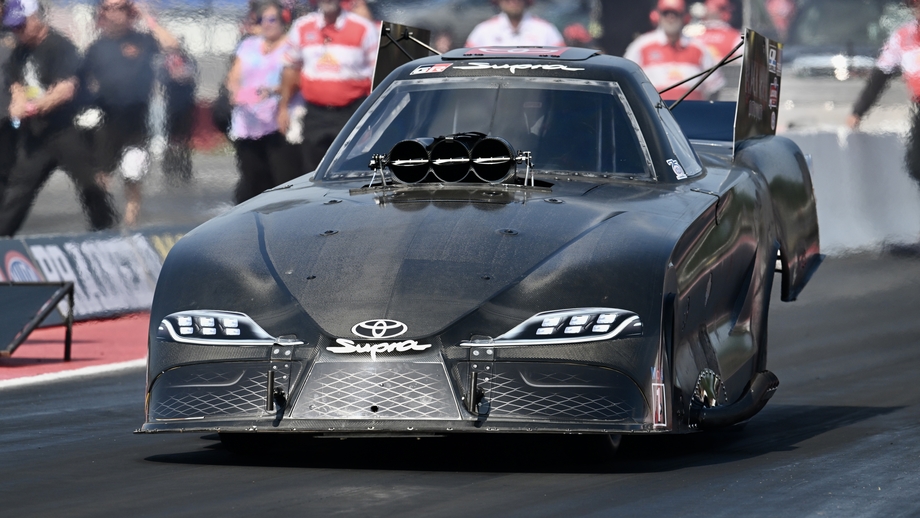
The unmistakable sound of a nitro-burning Hemi coming to life in the Brainerd International Raceway pits normally means one thing: Somewhere nearby, a 330-mph Funny Car or Top Fuel dragster is preparing to run.
This weekend, however, one of those engines is powering something different. Funny Car world champion Del Worsham and driver Jacob Slater have brought a unique Top Alcohol Funny Car to the NHRA Brainerd Nationals, where the car is serving as a technology demonstrator — and Brainerd is becoming a laboratory — for NHRA’s new supercharged nitromethane combination.
The concept is straightforward: Take much of the proven architecture and surplus componentry that already exists in the nitro pits, dramatically reduce its appetite and performance, and create another pathway into Top Alcohol Funny Car racing — one that could potentially become a steppingstone toward the NHRA Mission Foods Drag Racing Series.
NHRA approved the supercharged nitro combination for Top Alcohol Dragster and Top Alcohol Funny Car competition beginning in 2026 after Worsham initially proposed the concept and participated in testing. The combination joins the traditional supercharged methanol and injected nitromethane options available in the Top Alcohol categories.
At Brainerd, Slater and Worsham weren't simply trying to see how quickly they can make the car run. They were learning what it takes to make the concept fit competitively within Top Alcohol Funny Car.
“We’re making changes to try to figure out what the rules need to be on this car, in this class, to make it run with everybody else and not be a huge advantage or be a huge disadvantage,” Slater said. “We’re not just trying to get after it and do something crazy.”
That distinction is important. This isn't an attempt to disguise a modern Mission Foods Funny Car as an Alcohol Funny Car. Instead, the combination deliberately limits many of the tools available to its 12,000-horsepower cousins.
Nitromethane is restricted to 85%. Supercharger overdrive is limited to 16%. Only one magneto is permitted, and the clutch is limited to four discs and six primary levers with no clutch management system. The result is a combination that retains much of the mechanical DNA of a modern nitro Funny Car while substantially reducing its performance potential.
“It still has a Hemi,” Slater said. “The fuel system is pretty much the same as the big-show [Mission Foods Drag Racing Series nitro] car. It’s just scaled down. It’s not returning as much fuel, so you have a scaled-down pump, scaled-down blower drive. Clutch management is nonexistent.”
That simplicity is part of Worsham's vision. One of the hurdles facing racers who aspire to move from Top Alcohol Funny Car to the professional Funny Car category is that the equipment traditionally used in the two classes has little in common. Worsham has pointed out that when his family moved into nitro Funny Car racing in the late 1980s, much of their existing equipment could make the transition with them. Today, a racer can invest heavily in a competitive Top Alcohol operation [with a blown alcohol engine] only to essentially start over when moving to nitro. The supercharged nitro combination attempts to rebuild that bridge.
“If you come from a Top Fuel or Funny Car background, it’s very simple,” Slater said. “The whole plan is to make it as simple as possible so that if you build one of these with the intention of going to Funny Car or Top Fuel, it’s as simple of a transition as possible.” There is another intriguing part of the equation: parts.
Nitro teams routinely retire components long before the end of their potential service lives because of the extraordinary stresses associated with professional competition. Blocks, heads, blowers and other components that may no longer be considered desirable for a full-power Mission Foods Funny Car could potentially have a long second life in this less aggressive environment.
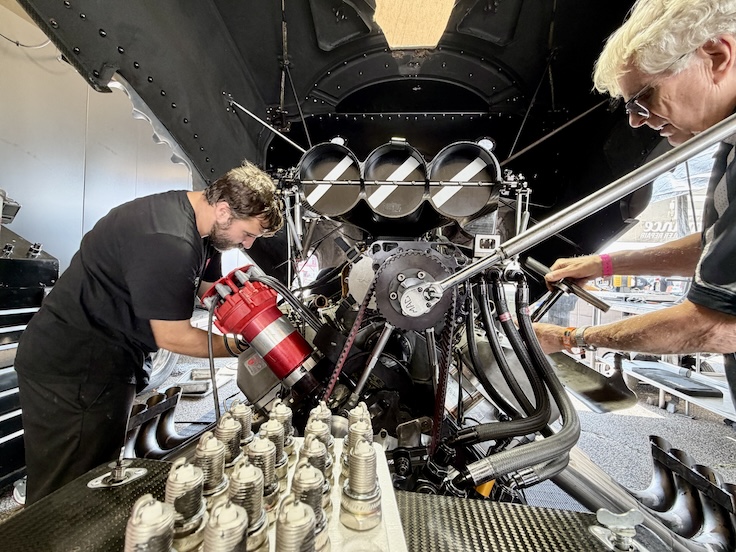
“You buy these parts used from the big teams that would last forever in a car like one of these, as long as you don’t do something that screws them up,” Slater said. “Once you get it all ironed out, this thing should be minimum maintenance. It gets a clutch every run, but it shouldn’t hurt any parts. The idea is to leave it together pretty much all day.”
The team actually demonstrated that potential at Brainerd. They disassembled the engine between runs, Slater said, primarily because they had the time and wanted to inspect what they were learning — not because the engine demanded it.
“We could have left it together,” he said. “We pulled it apart just because we had time.” But that doesn't mean development is finished.
Fuel volume, cylinder pressure, clutch setup and the overall performance window are still being explored. Slater said the team is deliberately approaching the project methodically because the objective isn't simply producing a spectacular elapsed time. It is gathering information that can help determine where the combination belongs. There is even an element of looking backward to move forward.
“You’ve got people around here like Jim Head or Del, people who have been racing for such a long time,” Slater said. “They remember back in the ’80s when we only had one mag, smaller pumps, the blowers weren’t as good and the tracks weren’t as good. They’re thinking back 40 years to figure out how much timing it should have and things like that.” For Slater, who has fewer than a dozen runs in the Funny Car, the experiment also provides exactly the type of experience Worsham hopes the combination can eventually offer other racers. And it still provides the unmistakable rush of driving a nitro Funny Car.
“When it makes a nice, good, smooth run, they’re usually the best runs and they’re the easiest ones to drive,” Slater said. “When something goes wrong, then it feels like you’re going quick really fast.”
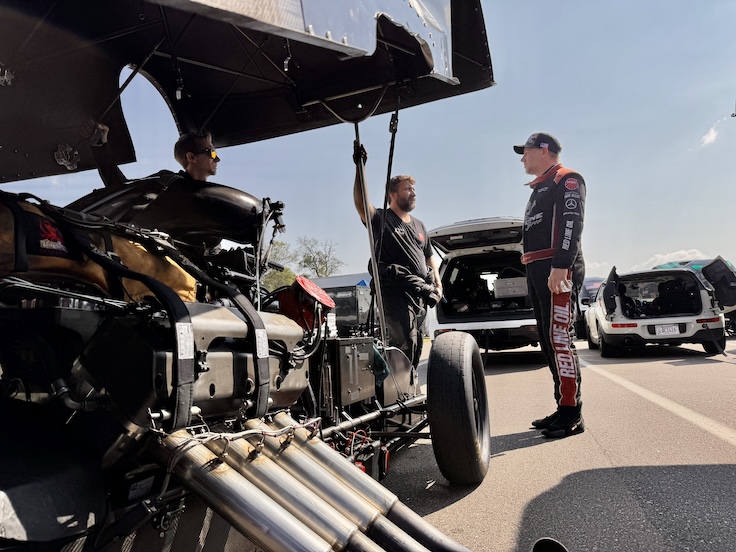
For now, nobody is declaring that the experiment has produced a finished formula. That is precisely why the car is at Brainerd. Every run adds another piece of information. Every inspection helps establish how hard the parts are working. Every tuning change helps Worsham, Slater and NHRA better understand how a supercharged nitro combination can coexist with the established Top Alcohol Funny Car combinations. And ultimately, the experiment is about something larger than one race car.
“Both classes need cars. Everywhere needs cars,” Slater said. “Everybody wants to see more Funny Cars, and I think there’s a home for this. We just have to run it to figure it out.”